Rathayatra - A Journey Within
In the journey of Life’s highway, the human body is chariot, the soul is the charioteer.
Rathe tu Vamanam Dristwa
As per the holy scriptures, in the path of devotion, it is believed that when a fortunate devotee who beholds the Lord on the Chariot, he is liberated from the vicious cycle of birth and death.
“Dole cha Dola Govindam, Chape cha Madhusudanam,
Rathe tu vamanam drustwa punarjanma na vidyate”
An ardent seeker, who has the fortune to behold Lord Jagannatha, in form of Lord Govinda in the festival of Dola Purnima, Lord Madhusudan in Chandan Yatra and a glimpse of the Vamana, the “dwarf” form on the chariot (Ratha) is liberated from the bondage of birth and death. A glimpse of Lord Jagannatha on the chariot is considered to be very auspicious and saints, poets and scriptures have repeatedly glorified the sanctity of this special festival. Even a touch of the chariot or even the ropes with which these are pulled is enough to confer the results of several pious deeds or penance for ages.
Let us dilate upon the metaphorical aspect of this message!
Rathe in Sanskrit means : In the chariot, what is a chariot?
The symbolic representation of Rath Yatra springs forth from the anecdote of the Kathaupanishad (1:3: 3rd & 4th Verse) where Lord of death Yamaraj is teaching young Nachiketa:
In the Vedic literature (Katha Upanishad 1.3.3–4) it is said:
“Atmanam rathinam vidhi Shareeram rathameva tu
Budhim tu sarathim vidhi Manah pragrahamevacha
Indriyani hayanyahur Vishayansteshu gocharan
Atmendriya manoyuktam Bhoktetyahur maneeshinah”
This body is the Chariot is the mortal frame; the Charioteer, owner of the chariot, is atman (soul or spirit); intellect is the Sarathi (coachman); horses are the senses and mind is the rein, Bishaya (the material objects) are the green pasture for the horses to graze. The union of the Soul (Atman), Senses(Indriya) and Mind (manah) one can realize the ultimate.
The individual is the passenger in the car of the material body, and intelligence is the driver. Mind is the driving instrument, and the senses are the horses. The self is thus the enjoyer or sufferer in the association of the mind and senses. So it is understood by great thinkers.” Intelligence is supposed to direct the mind, but the mind is so strong and obstinate that it often overcomes even one’s own intelligence. Such a strong mind is supposed to be controlled by the practice of yoga, but such practice is never practical for a worldly person like Arjuna. And what can we say of modern man? The simile used here is appropriate: one cannot capture the blowing wind. And it is even more difficult to capture the turbulent mind.
In Hatha Yoga Pradeepika importance of Pranayama is described as:
“Chale Vate Chalam Chittam Nishchale Nishchalam Bhavet,
Yogi Sthanutvamapnoti tato vayu nirodhayate”
When Prana(vital air we bretahe) moves, chitta(mind) also moves and when prana is without movement, chitta is also without movement. Prana and mind are intricately linked. So by steadiness of prana the yogi attain steadiness. Therefore it is important to retain the vayu by the practice of Pranayama.
Thus by bringing equanimity in breath, it is possible to behold the “Vamana” the Dwarf (soul) in the Ratha (Chariot of Body) the seeker emancipates from the cycle of Birth and Death.
Birth and Death
Maranam Bindupatenah, jeevanam bindu dharanat, which means the separation of consciousness from the atom point (soul) or deviation from incessant remembrance of supreme soul is death, union of the individual consciousness with cosmic consciousness is life.
The whole preparation for the grand Chariot Festival starts on the Sacred day of Akashyaya Tritiya. Chandan Yatra and Snan Yatra festival, in fact this festival gets under way a few weeks ahead of the main ritual which starts on Akshya Tritiya, when construction of idols begins in front of the Puri temple at King’s palace. This marks the beginning of the summer season when leaves turn green on the trees, flowers blossom, and farmers start ploughing their lands. Every day the idols are taken out in colourful procession for ceremonial boat-riding in the nearby Narendra Lake, which lasts for three weeks.
Let’s bring our focus back in the inner world again! The preparation of the body chariot begins on this day, if we prepare our body chariot (3 charriots, Gross Body – Talathwaja, Subtle body Darapadalana & Causal body Nandighosha) sincerely then the ultimate power of Jagannatha (Sudarshan) – the holy Darshan, which the Yogis call Self Realization or Nirvikalpa Samadhi state, the union with the comic consciousness.
In Bengali Bhajan by Ramprasad:
“Mon re krishi kaj jano na,
Emon manav jameen rolio pateet
avad korle phalat sona!”
which means Oh mind, don’t you know how to plough the the land of human body, if you know that you will harvest the ultimate wealth Gold. In Akshyatritiya the farmers take plough to their lands to start cultivation, in the inner world it means the sincere seeker start farming the filed of Body.
In Gita(13:01),
“idaṃ śarīraṃ kaunteya, kṣetramityabhidhīyate
etadyo vetti taṃ prāhuḥ, kṣetrajña iti tadvidaḥ”
Which means this body is the Kshetra (field), this is dhrma kshetra (Divine Field) , Kuru Kshetra (the battle field of Life), One who knows this, is called a Khejtrjna (knower of the Body).
This festival culminates in Snan (celestial bathing). The Snana Yatra festival takes place on the full moon day of the month of Jeystha. The idols are personified Gods to the devout Hindus. They are bathed using sandalwood (chandan) paste, and decorated with fragrance and flowers, and new dress put on. 108 pots of water from the golden well are collected to shower the Lord.
Lets comeback to the inner world again! In the scriptures it is cited:
“Snaanam Manah Malah Tyaga, Saucham Indriya Nigraha
Abheda Darshanam Jnanah, Dhyanam nirvishaya Manah.”
Snana is not just the bathing with water, it’s getting rid of propensities of mind and senses. Saucham, sanitation is controling senses, the non-dual vision (Abheda Darshana) is the knowledge and Meditation is the state of mind devoid of material world. 108 pots of water denotes the 12 months multiplied by 9 planets(rashis) and their effects on life, which points to the frame of time, Kala and its illusion.
Everybody can reach to the Supreme Lord by the Ratha of mortal frame. It is said: ‘Rathe tu vamanam drastwa, punar janmo naH bidyate’. An auspicious glimpse of the Vamana, dwarf form of Lord Krishna at Shrikhestra, assures emancipation from the cycle of birth and rebirth. That is the reason the multitude of devotees desire to touch the rope and Ratha to get liberation from this earthly journey. Many seers and saints have sung the praise of Lord Jagannath in holy scriptures like Kapil samhita, Skanda purana and Padma purana. The famous Oriya poet Upendra Bhanja in his noted work Vaidehisa Vilasha has depicted how Lord Jagannath’s blessings had redeemed the fallen beings who participate every year in this festival.
Sri Chaitanya Mahaprabhu epitomized the bhakti and surrender to Lord Jagannath while Jayadeva authored the Gita Govinda, the Love song of the Dark Lord – a treatise of surrender and love of the Lord for Radha. Both speak to spread the ripple of love to the infinite existence of the consciousness of Lord Krishna. Orissa culture has the universal principle of philosophy of colour of universal love; a rhythmic expression of the Lord Jagannatha with its unique cosmic rhythms and sweet sonic vibrations.
Rathyatra
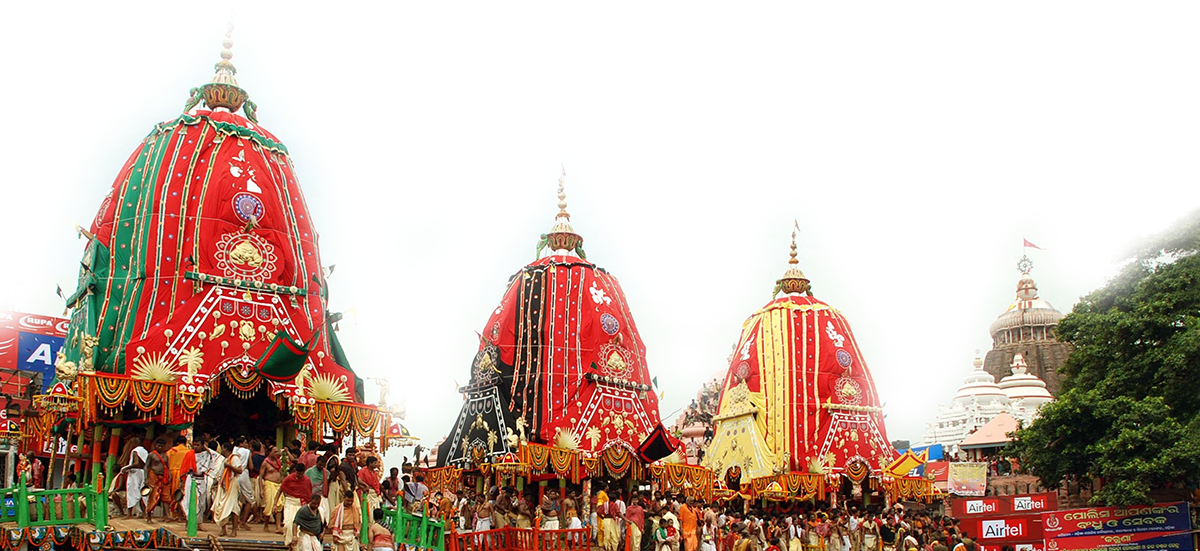
The tradition of Rath Yatra by installing an idol on a decorated chariot is known in India from time immemorial. The festival is observed on the day of Asadh Sukla Dwitiya, signifying the second day of the bright phase of 3rd lunar month of Asadh, to commemorate Lord Krishna’s annual visit to his aunt’s house known as Gundicha temple, two kilometers away from Puri’s main temple, for a royal stay of nine days. This year it fell on 29th June 2014. On this day, Lord Jagannath comes out of the sanctum sanctorum of Shri Kshetra, Puri Dham to meet all devotees — poor and rich, young and old and irrespective of caste, creed, colour, country, religion and race.
The Three Chariots
Three chariots – one each for Lord Krishna, Lord Balaram and Goddess Subhadra – are known as Nandhighosha, Talathwaja and Darpadalana. Nandhighosha for Lord Jagannatha, is a 45-feet tall structure with 16 wheels, decorated with yellow-red robes, while the Taladwaja for Lord Balaramn is 44 feet high with 14 wheels and decorated with blue-green clothes, and that of Goddess Subhadra called Darpadalana (trampler of pride) is a 43-feet tall chariot having 12 wheels and decorated with red-black cloth. Each chariot has a famous charioteer and four horses of different colours yoked to it. Lord Jagannath’s horses are black in colour while that of Lord Balaram are white; Goddess Subhadra’s horses are brown. Lord Krishna’s charioteer is Daruka while Lord Balaram’s charioteer is known as Matoli, and Goddess Subhadra’s charioteer is none but the great Arjuna.
Deva Snana Purnima
The celestial bathing ceremony of Lord Jagannath
Deva Snana Purnima is the celestial bathing ceremony of Lord Jagannath which takes place on the full-moon day of Jyestha month (May-June), to commemorate the birthday of Lord Jagannath. According to Skanda Purana, Raja Indradyumna performed this ritualistic bathing ceremony when he installed the wooden deities. Since that day, the divine dispersion of blissful rays has poured in thousands of devotees to assemble for a vast reaches of cosmic love in Puri (Odisha, India).
Jalabhisheka
The deities of Lord Jagannath, Devi Subhadra, and Lord Balabhadra are brought out of the Jagannath temple in a ceremonial Panhandi procession to the decorated Snana Bedi, an elevated bathing altar in the Ananda Bazar on the north-east corner of outer wall, meghanada pacheri for a grand ritual bath. Sudarsan and Madanmohan also join them. The bathing festival takes place in the morning hours of the Purnima day. One hundred and eight vessels are filled with water from a designated Suna Kua (Golden well) and purified with Haridra, Jaba, Benachera, Chandan, Aguru, flowers, perfumes, and medicinal herbs are brought from the Bhoga Mandap to Snana Bedi by Suaras/Daitapatis in a single-line procession. Prior to the ceremony, the idols of Lords are covered with silken fabric and smeared with red powder. Then water is poured on the Lords and the rituals are performed by chanting vedic matras and loud rejoicing. This ritual is known as “Jalabhisheka”. Thereafter, the Gajapati king performs chhera pahanra (sweeping with a golden broom) around the deities on the bathing alter.
Elephant Attire
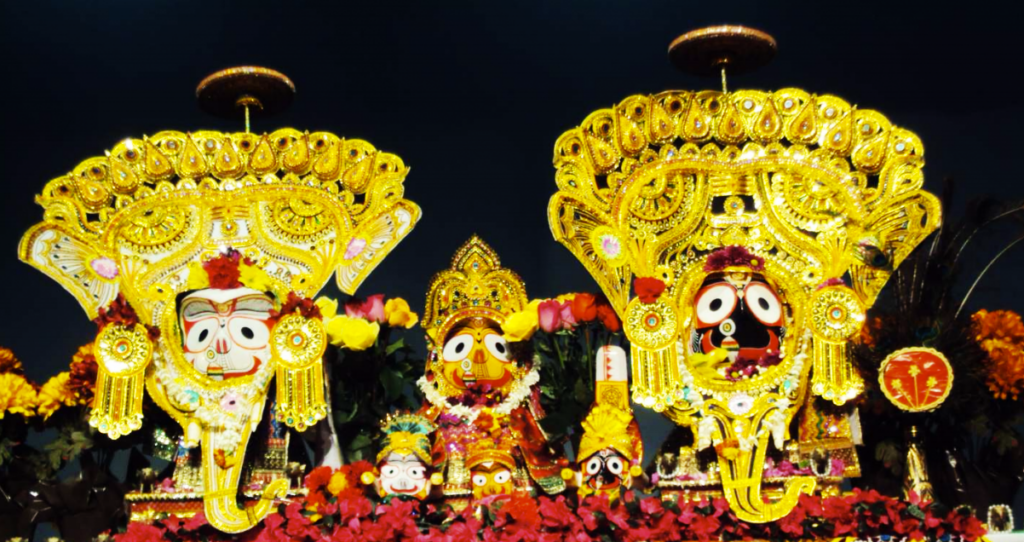
Following this, the deities are dressed in “elephant attire” popularly called “Hati Besha”. Lord Jagannath and Balabhadra present themselves in the form of Ganesha and Devi Subhadra apprears in Padma-besha. The costume is offered by Gopaltirtha Matha and Raghavdas Matha. This attire is especially dedicated to the famous devotee Ganapati Bhatta.
Anasara
After the holy bath, the Lords fall sick during their return journey from the Snana bedi. Instead of returning to their Ratna Singhasana, they concealed inside a closed room and suspend their daily darshan to the devotees for fifteen days. This period is known as Anasara or Anavasara meaning improper time for worship. In reality, not only, the colors of the deities are washed away due to grand water bath but also the wooden idols are partially damaged. The period of Anasara is used for repairing and repainting of the images for a fresh and lively public view. Surprisingly, the wooden images of the lords are painted not by the traditional painters but by the Daitapatis, the descendants of the tribal king Viswabasu who worshiped Nilamadhaba, an early form of Lord Jagannath.
Anasara Patti
During the anasara period the representative of the deities on canvas are kept inside the sanctum. Three patta paintings (cloth paitings) of the Trinity in black, white, and yellow colors are worshiped. These are known as Anasara Patti and are made by the traditional patta painters of Odisha. The Anasara patti represent the classical form of Narayan, Ananta, and Bhubaneswari with their original attributes to represent Jagannath, Balabhadra, and Subhadra, respectively. The incomplete, Lord Jagannath appears as Nayaran with full limbs in Padmasana holding Sankha (conch), Chakra (wheel), Gada (club) and Padma (lotus flower) in his four hands. The patta paintings that replace the idols are as old as the Jagannath temple of Puri.
Netrotsava
On the concluding day of anasara the deities dressed in the finest robes and ornaments appear before the millions of devotees. The festival of reappearance of Lord Jagannath after anasara is called Nava Jauvan (rejuvenation). On the next day the finishing touches are given to the eyes of the Trinity, and the festival is called Netrotsava and the Lords begin their celestial vacation to their aunt Gundicha during the Rath Yatra.